
Bioplasm NLS Analysis Machine: Understanding Quantum Entropy Logic and NLS Technology
- Sally
- April 04, 2023
- 1433
- 1
- 0
Introduction to Quantum Entropy Logic Theory
The theoretical background of modern Nonlinear Analysis Systems (NLS) is associated with the development of quantum entropy logic concepts and research into information exchange, biological systems, and nonlinear interactions.
Quantum Entropy Logic Theory, as described in certain NLS-related theoretical frameworks, explores how information may be associated with changes in the structural and energetic states of different systems. These concepts have been incorporated into explanations of how NLS technologies are designed to detect and analyze subtle signal variations.
The Bioplasm NLS Analysis Machine is designed around this general NLS analysis concept. By combining specialized signal-processing technology, digital sensors, computer algorithms, and graphical analysis tools, the system provides a platform for examining and visualizing biological information patterns.
Understanding the theoretical concepts behind NLS technology helps explain the system's proposed operating principles and its approach to computer-assisted biological analysis.
1. Quantum Entropy Logic and Information Exchange
Quantum Entropy Logic Theory describes information exchange between interacting systems through concepts such as association, selectivity, and changes in system states.
Within this theoretical framework, entropy is used to describe the degree of disorder or uncertainty within a system. Changes in the structural organization of a system may be associated with changes in its informational characteristics.
The theory proposes that interactions between two systems, A and B, may be influenced by their associated information patterns and structural conditions.
In certain interpretations, changes in one system may correspond to detectable variations in another related system. This concept provides part of the theoretical background used to explain the information-analysis approach of NLS devices.
It is important to distinguish these theoretical interpretations from established quantum physics principles. In particular, concepts such as quantum entanglement and the Einstein-Podolsky-Rosen (EPR) paradox should not be interpreted as proof that biological information can be transmitted instantaneously or that NLS analysis can directly measure quantum biological states.
2. The Relationship Between Biological Structures and Information Patterns
Biological systems are highly complex and continuously changing. Their structural organization, biochemical activity, and electromagnetic properties can vary in response to internal and external factors.
Within the theoretical model associated with NLS technology, biological structures and their corresponding information patterns are considered interconnected.
The theory proposes that changes in the condition of biological structures may be accompanied by variations in associated signal characteristics.
This concept forms part of the proposed foundation for the Bioplasm NLS Analysis Machine, which uses digital signal acquisition and computer-based processing to identify and display signal patterns.
Rather than relying solely on visual observation, NLS analysis aims to organize collected information into graphical representations that users can examine and compare.
3. The Operating Concept of NLS Analysis Technology
The operating concept of an NLS device involves signal acquisition, signal processing, and computer-assisted analysis.
In the theoretical descriptions of NLS technology, particular attention is given to changes in metastable structures and their associated signal characteristics.
A metastable state refers to a condition that can remain relatively stable under certain circumstances but may change when external conditions are modified.
Some NLS-related theoretical models propose that changes in these states may be associated with variations in electromagnetic or other measurable signal patterns.
The Bioplasm NLS Analysis Machine integrates specialized hardware and software to support the collection, processing, and visualization of such signals.
Its general technological workflow can be understood through several stages:
Signal Interaction: Specialized device components are used to establish the intended signal interaction with the analysis system.
Signal Acquisition: Sensors and electronic components collect available signal information.
Digital Processing: Acquired signals are processed through electronic circuits and computer algorithms.
Data Visualization: The software converts processed information into graphical interfaces and color-coded indicators.
Comparative Analysis: Users can review displayed patterns and compare different analysis results.
This combination of hardware and software provides the foundation for computer-assisted NLS analysis.
4. Electromagnetic Oscillations and Signal Processing
Certain NLS theoretical descriptions refer to magnetic oscillators, resonance characteristics, and changes in electromagnetic signal patterns.
In these models, biological systems are considered complex structures with multiple interacting components and dynamic properties.
The proposed NLS approach focuses on identifying variations in signal characteristics through specialized electronic components and digital processing techniques.
The Bioplasm NLS Analysis Machine uses its electronic architecture and computer software to process available signal information and present the results in an organized format.
Modern microelectronics and digital signal-processing technologies make it possible to detect, filter, and analyze relatively weak electrical signals within an electronic measurement system.
However, the ability to detect electronic signals should not automatically be interpreted as evidence that the system can directly identify specific cellular damage, molecular changes, or pathological conditions.
The interpretation of NLS-generated information should therefore be considered within the appropriate technical and scientific context.
5. Color-Coded Entropy Representation and Graphical Analysis
One of the distinctive features of many NLS software platforms is the use of color-coded graphical representations.
Within certain theoretical models, entropy levels are represented using a spectrum of colors. These may range from lighter shades, such as yellow, to darker shades, including orange, red, purple, and nearly black.
This visual approach is intended to make complex information easier to review and compare.
The Bioplasm NLS Analysis Machine incorporates computer-based visualization tools that allow users to examine graphical indicators associated with different anatomical models and analysis categories.
The software interface may present information through:
Color-coded graphical indicators.
Anatomical and organ-based computer models.
Comparative data displays.
Changes in displayed parameters over time.
Visual representations of different analysis categories.
By examining the distribution, intensity, and changes of these graphical indicators, users can review the software-generated information in a more structured manner.
It is important to understand that software colors are visualization parameters rather than independently validated measurements of organ health, tissue damage, or disease severity.
6. Frequency Selection and Biological Signal Analysis
Biological systems contain numerous interacting structures, each with different physical, chemical, and electrical characteristics.
NLS-related theoretical models propose that different signal characteristics may be associated with different biological structures and their corresponding states.
Accordingly, certain NLS systems use selectable analysis parameters and software-based comparison methods to organize information from different biological categories.
The Bioplasm NLS Analysis Machine combines its hardware configuration with computer algorithms to support the presentation and comparison of analysis results.
The software can organize information according to different anatomical models and analysis categories, allowing users to navigate between different sections of the interface.
These functions are intended to support structured information review rather than replace established diagnostic procedures or laboratory testing.
7. Computer-Assisted Analysis and Information Interpretation
A key feature of modern NLS technology is the integration of specialized hardware with computer software.
The analysis process involves more than signal acquisition. Digital processing, data organization, graphical presentation, and comparative interpretation are also important components.
The Bioplasm NLS Analysis Machine provides a computer-assisted environment in which users can:
Access different anatomical models and analysis categories.
Review color-coded graphical information.
Examine software-generated analysis results.
Compare displayed parameters.
Organize information for further review.
The graphical interface helps users navigate complex data more conveniently and provides a visual framework for understanding the system's analysis output.
The overall performance and interpretation of an NLS system depend on its hardware configuration, software algorithms, calibration, and the quality of the acquired signals.
8. Bioplasm NLS Analysis Machine: Integrating Theory and Digital Technology
The development of NLS technology reflects an effort to combine theoretical models of biological information with modern electronic engineering and computer-based analysis.
The Bioplasm NLS Analysis Machine brings together several technological elements:
Specialized electronic signal-processing components.
Digital signal acquisition technology.
Computer-assisted analysis software.
Anatomical visualization interfaces.
Color-coded graphical representations.
Comparative information-display functions.
These components work together to provide an integrated platform for exploring and reviewing NLS-generated information.
For practitioners and users interested in nonlinear analysis technology, understanding both the theoretical background and the practical software workflow is important when evaluating an NLS system.
Conclusion
Quantum Entropy Logic Theory and related NLS concepts provide one theoretical perspective on the relationship between biological structures, information patterns, and signal variations.
Building on these concepts, the Bioplasm NLS Analysis Machine integrates electronic signal processing, digital technology, and computer-based visualization to provide a structured environment for NLS information analysis.
By combining specialized hardware with graphical software tools, the system offers users an accessible way to explore different analysis categories and review computer-generated information.
For those interested in learning more about modern NLS technology and available equipment, explore the Biophilia Tracker Bioresonance Machine Collection to discover related systems and product configurations.
Important Note: NLS and bioresonance analysis technologies should not be considered substitutes for conventional medical diagnosis, laboratory examinations, or evidence-based medical treatment. The theoretical mechanisms described in this article should not be interpreted as established clinical findings.
Related Products
Biophilia Intruder Bioresonance Machine for Fast screening the Bacteria and Viruses
Each organ, tissue, and cell in our body has a distinct frequency which is made possible by the ro..

Bioplasm NLS 2 in 1 Bioresonance Machine - Aura Chakra Healing
The principles of 2 in 1 Bioplasm NLS developed by modern day Russian scientists reveal that ..
Biophilia Tracker 4D Bioresonance Machine - Aura Chakra Healing
We also have updated to New Biopiila Tracker X5 Ultra, if you are interested , please ch..
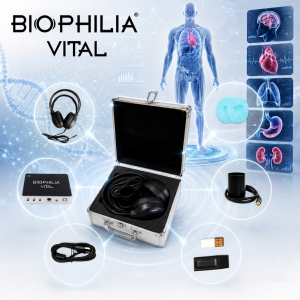
BIOPHILIA VITAL -Compact Bioresonance Analysis & Frequency Therapy System
Features Description: The Biophilia Vital is a kind of Pathomorphology, Microbiol..